
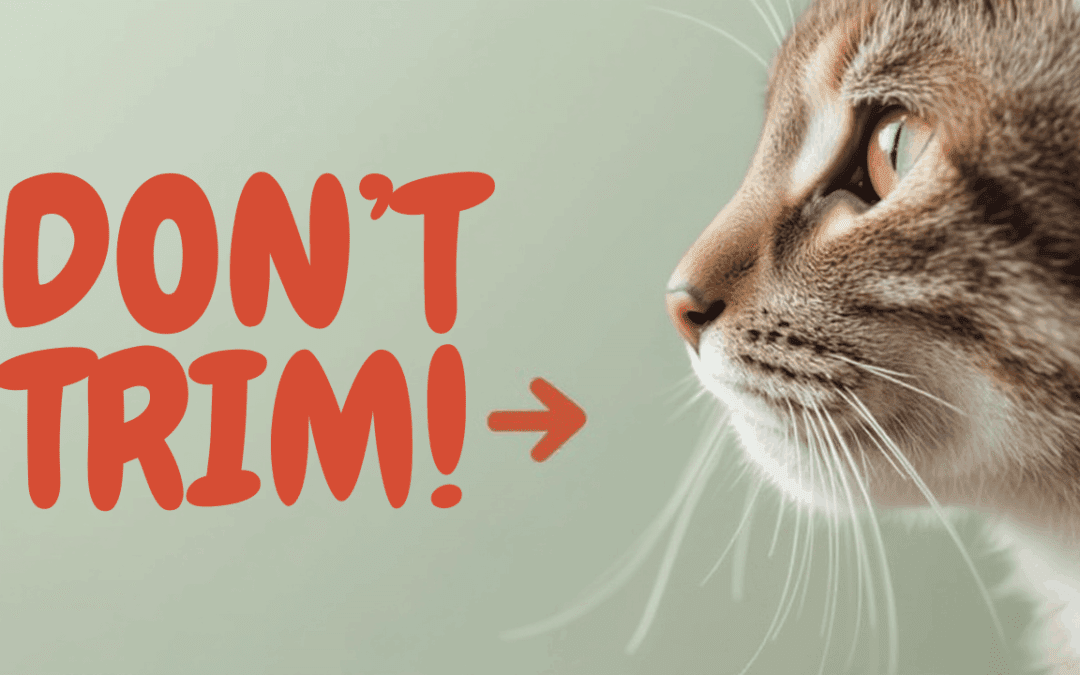
Every week we get great questions from pet owners, and today’s comes from Danny, who asks:
“If my dog or cat has their whiskers shaved, is that bad for them? And what should I do if it happens?”
It’s a great question—partly because whiskers are one of those features everyone knows are important, but most people don’t know why.
First, does trimming whiskers hurt?
Surprisingly, no.
The whiskers themselves don’t have blood vessels or nerve endings inside them. Cutting them doesn’t cause pain, and it’s not the same as cutting into living tissue.
Where it would hurt is if someone pulled the whisker out entirely. Like a nose hair, the follicle is innervated—so plucking it would absolutely be uncomfortable. But trimming the hair shaft? Not painful.
So why do whiskers matter?
Cats and dogs rely on their whiskers far more than most people realize. They use them for:
- Spatial awareness – “Can I fit through that space?”
- Sensing air currents – detecting movement around them
- Balance and orientation – a subtle but meaningful contribution
When you remove this sensory input, the world becomes less predictable. I usually compare it to this:
Stand on your tiptoes. Easy, right?
Now close your eyes. Not so easy anymore.
You can still balance, but you’ve removed a key sensory system that helps you do it smoothly. That’s exactly what whisker trimming does to dogs and (especially) cats.
It’s not inherently dangerous, but it can absolutely be disorienting and stressful.
Can trimmed whiskers lead to injury?
Potentially—yes.
If your pet is trying to do something physically demanding or requires precise navigation (jumping, squeezing through objects, climbing, etc.), missing their whiskers can make them more prone to misjudging distances or angles.
Think of whiskers like the “parking sensors” on your car. You can park without them, but you’re more likely to bump something.
What should you do if your pet’s whiskers were trimmed?
Usually, not much.
Here’s what I recommend:
1. Keep them indoors
This is especially important for cats. Without whiskers to help them navigate uneven surfaces or judge distances, outdoor risks increase significantly.
2. Limit physically demanding activity
No climbing, high jumps, rough play, or narrow balancing acts until the whiskers start to grow back.
3. Keep their environment predictable
Avoid rearranging furniture or adding new obstacles. Let them navigate a stable, familiar space.
4. Monitor them closely
If they seem unusually wobbly, confused, or uncoordinated, don’t assume whiskers are the only issue.
A neurological condition can look very similar.
If anything feels “off,” it’s worth having a veterinarian check them.
5. Give it time
Whiskers grow back. You don’t need ointments, supplements, or any intervention.
The bottom line
Trimming whiskers isn’t painful, and it isn’t a medical emergency. But whiskers are essential sensory tools for both cats and dogs, and removing them—even accidentally—can cause temporary disorientation and stress.
Keep your pet safe, keep them inside, let the whiskers grow back, and reach out to your veterinarian if anything doesn’t seem right.
And if you’re in the Vero Beach area and want to submit your own question, you know where to find us—Mermaid Vet Hospital at 772-925-1625.