
By Dr. Peter Mosites, Mermaid Vet Hospital – Vero Beach, FL
One of the most common questions I hear in the exam room is:
“Is my dog fat?”
It’s an important question — one that, if you’re asking, it’s either because you already suspect the answer, or a close friend (or maybe stranger), provided a rather blunt critique of your dog.
It’s also a question that has a bigger impact on your dog’s long-term health than most people realize. The good news is that you can learn to assess your dog’s weight accurately at home in just a few minutes.
Below, I’ll walk you through the simple checks I teach my clients, explain why weight matters so much, and show you what to do if your dog needs to lose a few pounds.
Why Your Dog’s Weight Matters More Than You Think
Obesity isn’t just “a few extra pounds.”
In veterinary medicine, obesity is one of the most common diseases we treat, and it’s linked to a wide range of serious health problems.
Keeping your dog at a healthy weight can:
- Extend their lifespan
- Reduce arthritis and joint disease
- Decrease the amount (and cost) needed for medications
- Lower anesthesia risks
- Improve mobility and energy
- Save you money on food and veterinary care
Many people ask if they should switch foods, buy supplements, or try “special” products to keep their dog healthy. The truth is that maintaining a healthy weight is one of the most powerful and effective things you can do.
How to Tell If Your Dog Is Overweight:
What is a “Body Condition Score”?
Is 60 lbs too much weight for a dog?
Well, that can be difficult to answer because of the variety of dog sizes and shapes we see. If it’s a dachshund, that is massively overweight. If it’s a great dane, it’s probably emaciated. If it’s a golden retriever, it might be “just right”.
Body condition scoring was developed to solve the problem of there being no standard healthy weight range for dogs, because their size and shape can vary so much.
It also serves to provide an example of what a dog’s body should look like at a healthy weight. In the United States, our mental image of a “healthy dog” tends to actually be overweight, and our mental image of an “overweight dog” is one that’s actually morbidly obese.
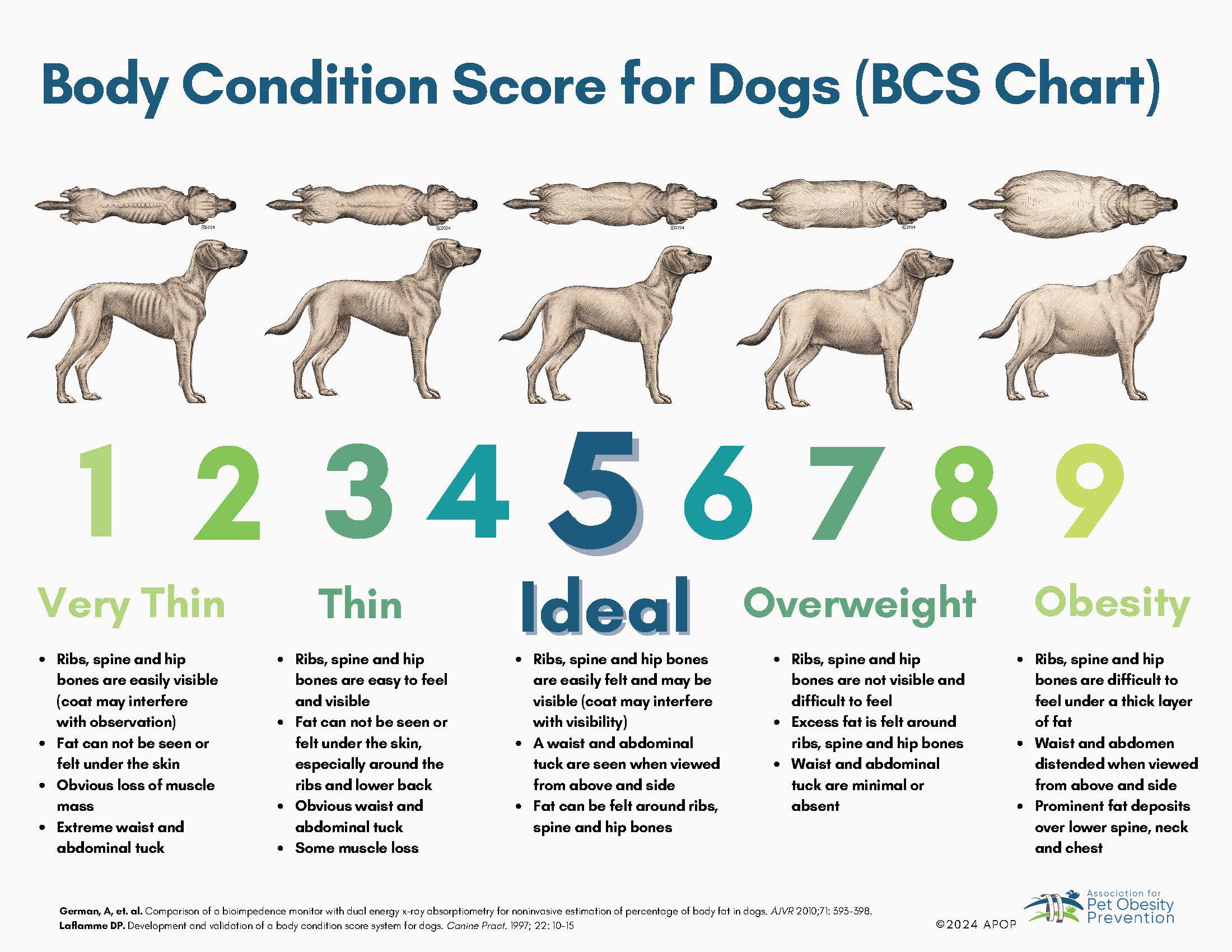
There are three simple visual and hands-on checks you can do at home to determine your dog’s body condition score: the rib test, the top-down test, and the side view test.
1. The Rib Test
Place your hand flat and run your fingers over the back of your knuckles.
That’s what your dog’s ribs should feel like — you can feel each rib easily, but they’re not sticking out.
Now compare it to your palm:
- Feels like knuckles on an open hand? ✔ Healthy weight
- Feels like your palm? ✘ Too much fat covering the ribs
- Feels like a closed fist? Too thin
You should be able to feel your dog’s ribs easily without seeing them.
2. The Top-Down View (The Hourglass Shape)
Stand over your dog and look down toward their waist.
You should see:
✔ A clear tuck inward behind the ribs
✔ An hourglass shape when viewed from above
If your dog looks:
✘ Flat from ribs to hips, or
✘ Round or oval-shaped,
…they’re likely overweight.
3. The Side View (The Abdominal Tuck)
Looking at your dog from the side:
✔ Their chest should be deep
✔ Their abdomen should slope upward toward the hind legs
If your dog looks like a straight rectangle (or worse, a sagging belly), they’re carrying extra weight.
Real Example: Stormy Passes All Three Tests
In the video, I examined Stormy:
- I could easily feel all her ribs
- She had a visible waist from above
- She had a healthy abdominal tuck from the side
That’s what you want to look for.
What to Do If Your Dog Is Overweight
Identifying the problem is step one.
Step two is taking safe, effective action.
1. Get an Accurate Weight
Most veterinary clinics — including ours — are happy to let you stop by and use the scale without an appointment.
This allows us to:
- Track progress
- Offer quick advice
- Catch other issues early
If you can’t get to a vet, use the “body weight subtraction method” at home:
1. Weigh yourself
2. Weigh yourself holding your dog
3. Subtract the difference
It’s not perfect, but it’s usually accurate within 1–2 pounds.
2. Measure Your Dog’s Food Correctly
This is where many owners unintentionally go wrong.
When someone says they feed “a cup,
” they often mean:
- A random mug
- A large scoop
- A Big Gulp-sized cup
A true measuring cup is 8 fluid ounces.
- Use a standardized cup every time so portions stay consistent.
- If you’re in need of a dedicated measuring cup for your dog, stop by the clinic!
We’re happy to provide one.
3. Use a Calorie Calculator
A great resource is the Oklahoma State University pet calorie calculator, which helps determine how many calories your dog should get each day based on:
- Age
- Weight
- Activity level
- Spay/neuter status
Once you know the target calories:
- Check your food bag or can for calories per cup or can
- Divide your dog’s daily calories into multiple meals, not all at once
4. Reduce Calories Safely
First, eliminate “empty calories”, by getting rid of all treats, including table food.
If this is too much, initially, and your dog is driving you crazy begging or breaking your heart with “puppy dog eyes”, start by switching to lower calorie alternatives. For commercial treats, you can try low calorie training treats, such as Charlee Bears. For table food, try switching to low fat greek yogurt and lower calorie, high fiber vegetables, such as celery and broccoli.
Once your pet is only receiving their regular diet, start with a 10% reduction in your dog’s total daily calories.
This small change often leads to steady weight loss without risking nutrient deficiencies.
If your dog isn’t losing weight after a few weeks:
- Double-check for treats
- Confirm family members aren’t sneaking snacks
- Remove extra supplements (not prescribed by your veterinarian) or adjust regular diet further to account for calories
Human food is extremely calorie-dense, so even small amounts can stall progress.
5. Talk to Your Veterinarian
If calories are controlled but weight doesn’t budge, it’s time for an exam to rule out:
- Thyroid disease
- Metabolic issues
- Mobility problems
- Other medical conditions
If no underlying disease is found, your vet may recommend a prescription weight-loss diet, which provides all essential nutrients with fewer calories.
Never simply “feed less” of a regular diet — this leads to nutritional deficiencies over time.
6. Add Controlled Exercise
Just like people, dogs benefit from:
- Low-impact
- Steady
- Aerobic exercise
Aim for:
20 minutes a day, and if you can manage 2–3 sessions, that’s fantastic.
For many dogs, even one structured walk a day is a huge improvement over baseline activity levels at home.
7. Consistency Is Everything
Dogs are biologically built to hold onto fat — it helped their ancestors survive periods without food.
That means weight loss requires:
- Time
- Patience
- Consistency
- Regular weigh-ins
- Ongoing communication with your veterinary team
And of course, we’re always here to support you.
Final Thoughts
Weight management is one of the most effective ways to give your dog:
- A longer life
- A healthier body
- Better mobility
- Fewer medical issues
If you’re in the Vero Beach, FL area, feel free to stop by Mermaid Vet Hospital anytime for a weight check or make an appointment for personalized pet nutrition guidance.
Your dog deserves to feel their best — and we’re here to help make that happen.